
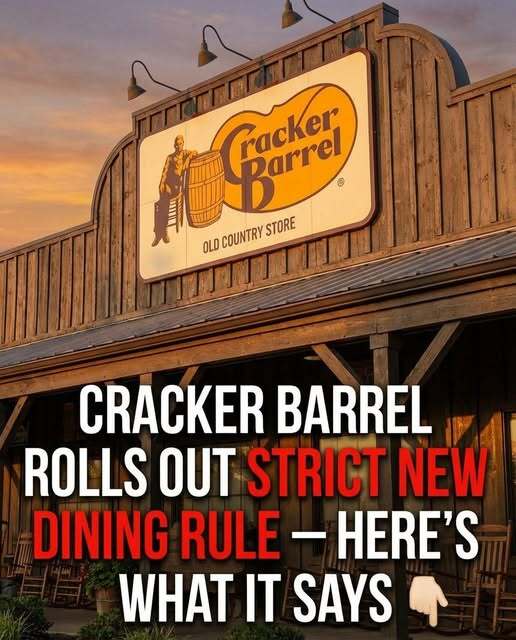
ker Barrel Responds to Change With Updated Travel and Dining Guidelines
By John Revokee
March 18, 2026
For decades, a road trip across America has felt incomplete without the sight of a wooden porch, rocking chairs, and the promise of a homestyle meal inside. The highways may stretch endlessly, but certain landmarks signal comfort long before hunger sets in. Among those familiar beacons stands Cracker Barrel, a brand woven into the fabric of American travel.
Cracker Barrel built its reputation on nostalgia, comfort food, and a country-store atmosphere that made travelers feel at home. From checkerboards balanced between diners to shelves lined with old-fashioned candies and tin signs, the experience was designed to slow time down. It wasn’t just a restaurant; it was a pause button on the rush of modern life.
But as customer expectations evolve, even beloved brands must adapt. The world outside those wooden doors has changed rapidly, shaped by digital convenience, shifting tastes, and new generational values. What once felt timeless must now compete with a culture that rarely stands still.
In recent years, Cracker Barrel has walked a careful line between refreshing its image and preserving the traditional charm that loyal guests associate with its name. The challenge is delicate: update too little and risk irrelevance; change too much and risk alienation. Few brands face that tension as publicly as one built so firmly on nostalgia.
Balancing innovation with heritage has become central to its strategy. Executives and designers alike have had to ask difficult questions about what truly defines the brand. Is it the rocking chairs? The cast-iron skillets? Or is it the feeling those symbols create?
One notable shift came with updates to the company’s logo and restaurant interiors. The refreshed branding aimed to simplify visual elements, brighten dining spaces, and subtly modernize typography. The goal was not reinvention, but refinement.
The goal was to modernize the brand and appeal to a broader audience while staying rooted in its legacy. Leadership understood that younger diners, raised in sleek fast-casual spaces, might crave a cleaner aesthetic. At the same time, longtime guests cherished every creak of the wooden floorboards.
However, the refreshed look sparked mixed reactions among longtime customers, some of whom felt the changes strayed too far from the familiar aesthetic. Social media quickly filled with side-by-side comparisons of “before” and “after.” For some, the brighter palette felt like a departure from the warm glow they remembered.
After listening to feedback, Cracker Barrel adjusted its approach, restoring certain classic design elements while continuing subtle improvements behind the scenes. Rocking chairs remained steadfast out front. Decorative pieces reclaimed prominence on interior walls. The brand recalibrated rather than retreated.
The experience underscored how deeply connected patrons are to the brand’s identity and tradition. It revealed something powerful: customers weren’t resisting change itself; they were protecting a memory. In an era where so much feels disposable, Cracker Barrel represents continuity.
More recently, internal employee travel policies drew attention. Reports suggested staff were encouraged to dine at Cracker Barrel locations when traveling for work. In an age of corporate transparency, even internal memos can spark public conversation.
Company representatives clarified this was guidance, not a requirement, and employees could choose other options when necessary. The clarification aimed to quell speculation and reinforce flexibility. Leadership emphasized trust rather than mandate.
The company also reviewed aspects of its expense policies, providing clearer guidelines around meal reimbursements to ensure transparency and consistency. Clearer communication became the quiet hero of the moment. By tightening language and expectations, the company sought alignment rather than control.
These steps reflect an effort to support employees while reinforcing brand loyalty. Encouraging team members to experience their own restaurants can deepen understanding and pride. Yet doing so thoughtfully ensures morale remains intact.
Through these adjustments, Cracker Barrel emphasizes its commitment to hospitality and tradition while adapting to a changing marketplace. The brand’s heartbeat has always been service — not just plates of food, but warmth extended across a table. That ethos now guides decisions both public and private.
It continues participating in community initiatives and national events, positioning itself as a gathering place for families and travelers alike. From holiday promotions to charitable partnerships, the company maintains a visible presence beyond its dining rooms. Community engagement strengthens the sense of belonging guests feel.
The company’s recent updates illustrate that even well-established brands must evolve thoughtfully — not by abandoning what made them special, but by refining how they carry those values forward in a modern world. Change, when handled carefully, becomes an extension of tradition rather than its enemy.
Behind the scenes, strategy meetings now weigh sentiment as heavily as sales metrics. Data may inform direction, but emotion defines loyalty. Few companies enjoy the privilege of multigenerational attachment; fewer still manage it wisely.
There is a cinematic quality to the brand’s journey — a cross-country highway at dusk, porch lights glowing against a darkening sky. Families step out of minivans, grandparents recalling visits from decades prior. Children press their noses to the country-store glass, discovering simple joys for the first time.
Such imagery is not accidental. It is cultivated, protected, and occasionally recalibrated to match contemporary sensibilities. The art lies in knowing which threads of nostalgia to preserve and which to gently reweave.
Modern diners expect digital menus, efficient service, and transparency in sourcing. They also crave authenticity, even if they struggle to define it. Cracker Barrel’s task is to meet those expectations without losing the texture that made it iconic.
In many ways, the debate surrounding its updates mirrors a broader American conversation. How do institutions modernize without erasing their past? How do companies stay competitive without becoming indistinguishable from one another?
The answers are rarely found in sweeping transformations. Instead, they live in incremental shifts — a slightly brighter dining room, a clarified travel policy, a restored decorative accent. Evolution becomes a series of measured steps rather than a leap.
Customers, too, play a role in shaping that evolution. Their feedback, whether voiced at a hostess stand or online, influences real decisions. The brand’s willingness to listen demonstrates that tradition is strongest when it remains responsive.
As the restaurant industry grows increasingly crowded, differentiation matters more than ever. Many chains compete on speed or novelty. Cracker Barrel competes on memory.
And memory is a powerful currency. It draws travelers off exits they might otherwise pass. It convinces families to gather around familiar tables during holidays and long weekends.
Ultimately, the story unfolding is not one of crisis, but of calibration. It is about a company recognizing that loyalty is earned repeatedly, not inherited indefinitely. Heritage provides a foundation, but relevance builds the future.
Cracker Barrel’s journey reminds us that adaptation does not require abandoning identity. It requires understanding it more deeply than ever before. In the steady rhythm of rocking chairs and the quiet hum of highway traffic outside, the brand continues to navigate change — carefully, deliberately, and with an eye on both yesterday and tomorrow.
Recommended Viral Title (20 words):
Cracker Barrel’s Bold Balancing Act: How America’s Road Trip Icon Is Reinventing Tradition Without Losing Its Soul